My editing bookshelf
The print and digital resources I use for my editorial practice
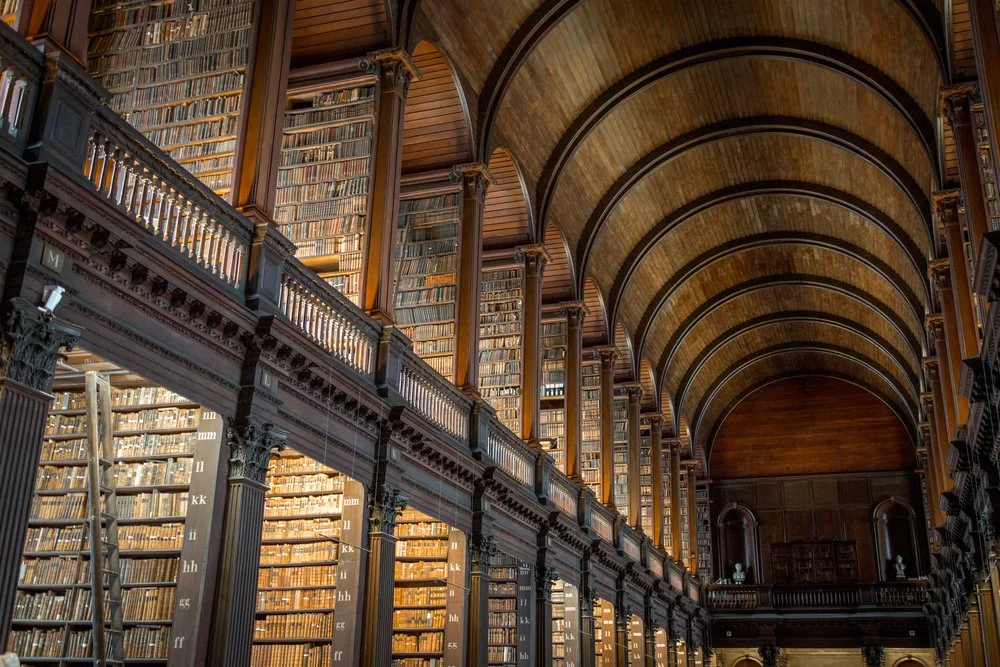
Shutterstock / JulianBuijzen / The Long Room in the Old Library at Trinity College, Dublin. The chamber is two stories high and 65 metres long, with wooden bookshelves and handrails, and a curved ceiling down the centre of the room. The shelves are filled with thousands of old books.
Every editor’s bookshelf is unique, a reflection of their experience, interests and expertise. A science editor’s bookshelf will be vastly different from a fiction editor’s bookshelf, but they will still share some common resources. Here is a short summary of the books I keep close to hand, both in the physical sense with print editions, and virtually, with electronic resources.
Dictionaries and thesauruses
Most of my work is with clients based in Australia, so the dictionaries and thesauruses I use reflect this geographic location.
Macquarie Dictionary Online (online, subscription)
Australian Oxford Dictionary, 2nd edition (online, subscription)
Both of these dictionaries are available online for free through the National Library of Australia.
Style guides
As a science editor, I use several style guides that focus on the presentation of science. My other style guides are particular to Australian Government editing or Australian style.
The CSE Manual: Scientific Style and Format for Authors, Editors, and Publishers, 9th edition (online or print, Council of Science Editors and The University of Chicago Press, 2024)
The Chicago Manual of Style Online, 18th edition (online or print, The University of Chicago Press, 2024)
Australian Government Style Manual (online, Commonwealth of Australia, 2025)
The Aboriginal Studies Press Style Guide for Editors (PDF, Australian Institute of Aboriginal and Torres Strait Islander Studies (AIATSIS) and Aboriginal Studies Press, 2025)
In 2024 I wrote a book review of the 9th edition of The CSE Manual for Publishing Research Quarterly. It is available online via subscription or institutional access.
Many of my clients who belong to large organisations or government departments have their own style guides, which will include information specific to their organisation and subject matter. For example, the Food and Agriculture Organization of the United Nations (FAO) has its own style guide that covers its publication process, names of countries and geographic areas, and FOA-specific terms.
Grammar and punctuation books
I often refer to sources to double-check grammar and punctuation. These are some of my most-used books.
The Little Green Grammar Book by Mark Tredinnick (print, UNSW Press, 2008)
Bloomsbury Grammar Guide by Gordon Jarvie (ebook and print, Bloomsbury, 2007)
The Penguin Guide to Punctuation by RL Trask (ebook and print, Penguin, 2019)
Books on language and usage
I also refer to a number of books on language. These books centre on English usage and conscious language that is appropriate for the context of the writing and expected audience.
The Cambridge Guide to Australian English Usage by Pam Peters (out of print, Cambridge University Press, 2007)
The Elements of Style, 3rd edition, by W Strunk Jr and EB White (print, Macmillan Publishing Company, 1979)
The Conscious Style Guide by Karen Yin (ebook and print, Scribe, 2024)
Talking About People: A Guide to Fair and Accurate Language by Rosalie Maggio (print, Bloomsbury, 1997)
Editing for Sensitivity, Diversity and Inclusion, 2nd edition, by Renée Otmar (ebook and print, Cambridge University Press, 2023)
Specialist resources
Sometimes I need to search out information specific to a particular publication type, or something that is quite technical. I’ve listed a few of my most-used resources here, but I have online bookmarks for over 150 specialist resources.
Accessibility and plain language
Books without Barriers: A Practical Guide to Inclusive Publishing by Julie Ganner et al. (ebook, Institute of Professional Editors and Australian Publishers Association, 2023)
Inclusive Publishing in Australia: An Introductory Guide by Greg Alchin and Julie Ganner (ebook, Australian Inclusive Publishing Initiative, 2019)
ISO 24495-1:2003, Plain Language – Part 1: Governing Principles and Guidelines (online)
W3C Accessibility Standards (online)
Data visualisation
Effective Data Visualisation: The Right Chart for the Right Data, 2nd edition, by Stephanie DH Evergreen (ebook and print, Sage, 2019)
The Visual Display of Quantitative Information, 2nd edition, by Edward Tufte (print, Graphics Press, 2001)
First Nations content
Guidelines for the Ethical Publishing of Aboriginal and Torres Strait Islander Authors and Research from those Communities (PDF, Aboriginal Studies Press and AIATSIS, 2015)
Names of places and things
Atlas of Living Australia (online, CSIRO, 2025)
NIH National Library of Medicine (online, National Center for Biotechnology Information, 2025)
ELVIS Place Names (online, Intergovernmental Committee on Surveying and Mapping, 2025)
FAO Names of Countries and Territories (NOCS) database (online, FAO, 2025)
Books about editing
I also keep books about how to edit. These are some of the Australian editing profession’s most respected books on the subject.
The Australian Editing Handbook, 3rd edition, by Elizabeth Flann, Beryl Hill and Lan Wang (ebook and print, John Wiley & Sons, 2014)
The Editor’s Companion, 2nd edition, by Janet Mackenzie (ebook and print, Cambridge University Press, 2011)
Working Words, revised edition, by Elizabeth Manning Murphy (ebook and print, Lacuna Publishing, 2019)